Saudi Arabia's Elephant Rock

Raghu Yadav
| 14-04-2026

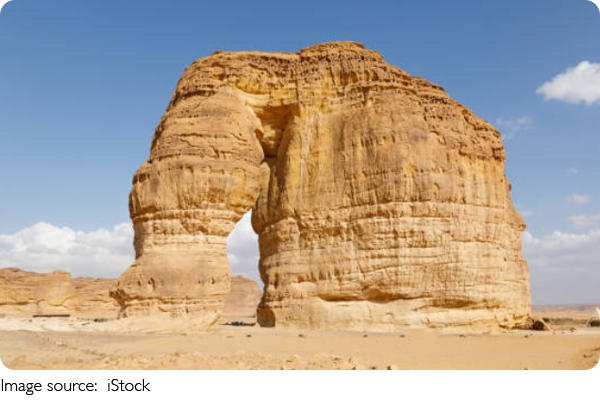
Somewhere in the vast sandstone landscape of northwestern Saudi Arabia, nature spent millions of years sculpting something that looks unmistakably deliberate.
A rock formation rises from the desert floor, its arch curving downward like a trunk, its massive body sitting with the weight and presence of the largest land animal on earth.
No artist shaped it. No engineer planned it. The wind and time did all the work — and the result is one of the most visually arresting natural landmarks in the entire Arabian Peninsula.
Elephant Rock, known locally as Jabal AlFil, sits near the ancient city of AlUla in the Medina region of Saudi Arabia. It has existed in the desert for millennia, known to local communities for generations. In recent years, as Saudi Arabia has opened its doors to international tourism, Elephant Rock has emerged as one of the country's most talked-about natural attractions — and the infrastructure surrounding it has developed rapidly to match the growing interest.
Elephant Rock
What Makes Elephant Rock So Remarkable
The formation stands approximately 52 meters tall — roughly equivalent to a 17-story building — and is composed of ancient sandstone that has been shaped over millions of years by wind erosion. The process that created it, called differential weathering, occurs when softer layers of rock erode faster than harder layers, leaving behind shapes that the human eye instinctively reads as familiar forms.
In the case of Jabal AlFil, the resemblance to an elephant is not a matter of squinting and imagining. The arch that forms the trunk, the rounded mass of the body, and the scale of the entire formation combine to produce something that reads as a recognizable silhouette from multiple angles and distances. Photographers who have visited describe it as one of the few natural formations that actually delivers on its name without requiring any interpretive generosity.
The surrounding landscape amplifies the effect. The flat desert floor around the formation provides an unobstructed view from a significant distance, and the warm tones of the sandstone shift dramatically across the day as the light changes — pale gold in the morning, deep amber in the afternoon, and a glowing ochre in the final hour before sunset that turns the rock into something genuinely spectacular.
Getting There
Elephant Rock is located approximately 11 kilometers from AlUla town center, in the AlUla region of northwestern Saudi Arabia. The nearest major airport is Prince Abdul Majeed bin Abdulaziz International Airport in AlUla, which receives domestic flights from Riyadh, Jeddah, and other Saudi cities. International visitors typically connect through Riyadh or Jeddah before taking a domestic flight to AlUla.
From AlUla airport, the drive to Elephant Rock takes approximately 15 to 20 minutes by car. Taxis and rideshare services are available from the airport, with a one-way trip to the Elephant Rock area costing approximately $10 to $20 depending on the service.
Rental cars are available at AlUla airport from approximately $40 to $70 per day, which provides the most flexibility for exploring the wider AlUla region, including Hegra — the UNESCO World Heritage Site containing ancient Nabataean tombs — and the various canyon formations and rock art sites scattered across the surrounding desert.
Opening Hours and Practical Information
Elephant Rock and the surrounding area are open to visitors throughout the year. The site itself has no formal entry fee, though the broader AlUla region has developed a range of ticketed experiences and guided tours that can be booked through the Experience AlUla platform.
The most popular visiting times are sunrise and the two hours before sunset, when the light transforms the sandstone into its most photogenic states. Midday visits during summer months should be approached with significant preparation — temperatures in the AlUla desert regularly exceed 100 degrees Fahrenheit between late spring and early autumn, and shade is minimal at the formation itself.
A dedicated visitor area with lighting has been developed around Elephant Rock, making evening visits viable and increasingly popular. The illuminated formation after dark offers a completely different visual experience from the daytime visit and has become one of the signature images associated with modern AlUla tourism.
1. Best visiting time for photography — one hour before sunset for warm natural light.
2. Best visiting time for comfort — October through March, when temperatures are significantly more moderate.
3. Evening visits — the lit formation is accessible after dark and the desert air cools considerably after sunset during cooler months.
Where to Stay Nearby
AlUla has developed a genuinely impressive hospitality offering in recent years, ranging from internationally branded luxury properties to boutique desert camps that place guests directly within the landscape.
Habitas AlUla is one of the most celebrated properties in the region — a collection of tented suites set among ancient palm groves and sandstone formations, with rates beginning at approximately $400 per night. The design integrates naturally with the surrounding landscape and the property offers excursions throughout the AlUla region.
Shaden Resort AlUla offers a more accessible option with traditional Saudi architectural influences and comfortable rooms from approximately $180 per night. For travelers seeking an immersive desert experience, several licensed desert camp operators in the AlUla area offer overnight stays in furnished tents from approximately $120 to $200 per night, with the added experience of sleeping under one of the clearest skies in the region.
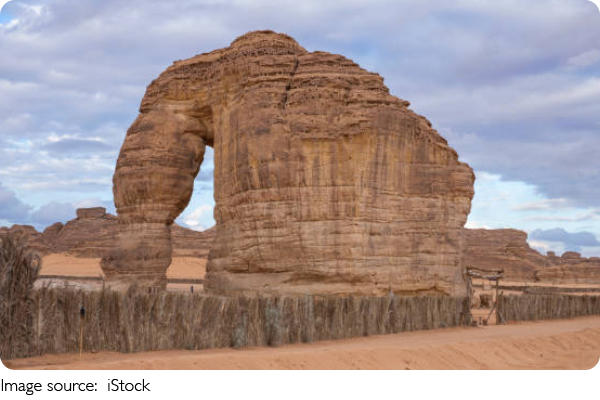
Elephant Rock is the kind of landmark that earns its reputation not through marketing but through the simple fact of what it is — a formation so visually specific, so unexpectedly perfect in its resemblance, that standing in front of it produces the particular satisfaction of encountering something that exceeds rather than merely meets its description.
The desert made it. The light reveals it differently every hour. And the experience of seeing it in person, in the silence of the Arabian landscape, is considerably more than any photograph can fully prepare you for.